
Gradial home
Governed workflow connecting agents, people, systems, approvals, and verified outcomes
All blogs
GuideAug 21, 2026

What Is a Marketing Harness? The Operating Layer for Agentic Marketing

Gradial
Marketing HarnessAgent HarnessMarketing OperationsEnterprise Marketing

A marketing harness is the operating layer that gives agents the context, systems, workflow controls, and governance required to execute real marketing work. It connects the approved brief to the CMS build, DAM asset, email, QA evidence, approval, launch decision, and measurement signal without asking a person to rebuild the context at every handoff.

Most teams can build or buy an agent that drafts copy, summarizes research, or calls a tool. That is not the hard part anymore. The hard part is making the agent trustworthy when the work crosses brand rules, customer data, systems of record, compliance review, and production release. A marketing harness is what closes that gap.

This guide is the marketing implementation of the broader agent harness model. It focuses on the controls required between an approved marketing decision and a verified customer experience.


What is a marketing harness?

A marketing harness is a governed system of work for agents and people. It provides reusable marketing context, coordinates tasks across teams and tools, limits what each agent can do, collects the evidence reviewers need, and verifies the final experience.

The harness is not another content generator. It is the operational environment that lets specialized agents participate safely in marketing execution.

Marketing requirementHarness responsibilityExample
Approved directionCapture objective, audience, offer, sources, channels, owners, and definition of doneA launch brief becomes scoped work
Brand and product contextApply current messaging, claims, terminology, design, and product factsEvery channel uses the same approved source
Connected executionRoute authorized actions across CMS, DAM, ESP, CDP, CRM, analytics, design, and workflow systemsA reviewed update is built where it will ship
Governed decisionsSeparate drafting, editing, approval, activation, and publication authorityA completed draft cannot silently go live
Evidence and learningPreserve sources, changes, checks, outcomes, and approved correctionsReview gets faster and future work improves

Why marketing harness is emerging now

Agent harness language moved into the technical mainstream in 2026 as teams focused less on isolated prompts and more on the infrastructure that makes agents reliable. Marketing harness extends that idea to a function where execution crosses many systems and carries public brand, customer, legal, and revenue consequences.

Public usage of “marketing harness” is still early and inconsistent. Some practitioners use it for a brand-aware content generator. Others use it for an agent that manages one channel. Gradial’s point of view is more specific: a marketing harness is the governed operating layer that coordinates people and agents across the full path from approved direction to a verified customer experience.

That definition matters because marketing does not need another name for content generation. It needs a system that keeps the brief, brand, product facts, assets, audience decisions, approvals, release authority, and measurement connected while work moves across the stack.

Why marketing AI demos do not become production workflows

  • The brief is not executable: The goal is clear, but the audience, source, destination, protected scope, owner, or acceptance criteria are missing.
  • Context is scattered: Brand guidance, product facts, prior approvals, designs, and market rules live in different systems or conversations.
  • The output stops too early: An agent produces copy or a recommendation, then an operator still has to build, tag, route, check, and publish it.
  • Governance arrives late: Brand, accessibility, legal, privacy, and channel checks happen after the work is assembled.
  • Release authority is unclear: Drafting, approval, campaign activation, and publication are treated as one permission.
  • No one verifies the experience: A system reports success, but the page, email, segment, or campaign does not match the intended result.

A marketing harness turns each of these failure points into an explicit control.

The eight controls inside a marketing harness

  1. Intake control: Validate the objective, audience, source, scope, destination, owner, risk, and definition of done.
  2. Context control: Select current brand, product, audience, design, workflow, legal, and market guidance.
  3. Planning control: Break the request into dependent and parallel steps across content, creative, systems, reviews, and measurement.
  4. System control: Give each agent only the connected tools, records, environments, and actions required for its task.
  5. Quality control: Run brand, factual, accessibility, link, metadata, rendering, and channel checks before review.
  6. Decision control: Route the exact change, evidence, exception, and requested decision to the accountable person.
  7. Release control: Keep draft, approval, activation, publication, verification, and recovery as distinct stages.
  8. Learning control: Use approved feedback and performance signals to improve future work without replacing human strategy.

How a marketing harness moves work from brief to live

StageHarness actionHuman responsibility
1. IntakeClassify the request, find missing inputs, set scope, and identify ownersConfirm priority, audience, and intended outcome
2. PlanCreate the sequence, dependencies, review gates, and system assignmentsApprove strategy and protected decisions
3. ProducePrepare content, creative, variants, assets, pages, emails, segments, and metadata in connected systemsMake creative and strategic calls
4. CheckRun policy, brand, factual, accessibility, technical, and experience checksResolve judgment-based exceptions
5. ReviewPresent sources, changes, checks, risks, and the exact decision requiredApprove, reject, or request a specific change
6. ReleaseAdvance only the approved scope through activation or publication controlsAuthorize consequential live actions
7. VerifyConfirm the customer-visible result and connected system stateAccept the outcome or initiate recovery
8. LearnConnect workflow, quality, cost, and audience signals to the next iterationChange strategy, policy, and priorities

Where a marketing harness creates leverage

  • Campaign operations: Turn an approved plan into tasks, channel assets, approvals, launch readiness, and measurement without manual status chasing.
  • CMS authoring: Build and update structured pages, connect approved assets, run checks, and prepare rendered previews for review.
  • DAM operations: Find the approved asset, validate rights and metadata, prepare the correct rendition, and verify placement.
  • Email operations: Build channel-ready drafts from approved sources, preserve templates, run checks, and keep sending authority separate.
  • Personalization: Turn audience and performance signals into the landing pages, emails, and channel variants each segment needs, with approvals and audience mapping attached.
  • Search and AI visibility: Move from demand or visibility findings to governed content changes, technical updates, and measurement.
  • Localization: Create structured market variants from a controlled source while preserving terminology, protected content, and local exception review.

How Gradial acts as a marketing harness

Gradial is the marketing operations system of work for enterprises. It connects the existing stack, applies reusable business context, and lets agents execute the operational work between approved direction and a verified customer experience.

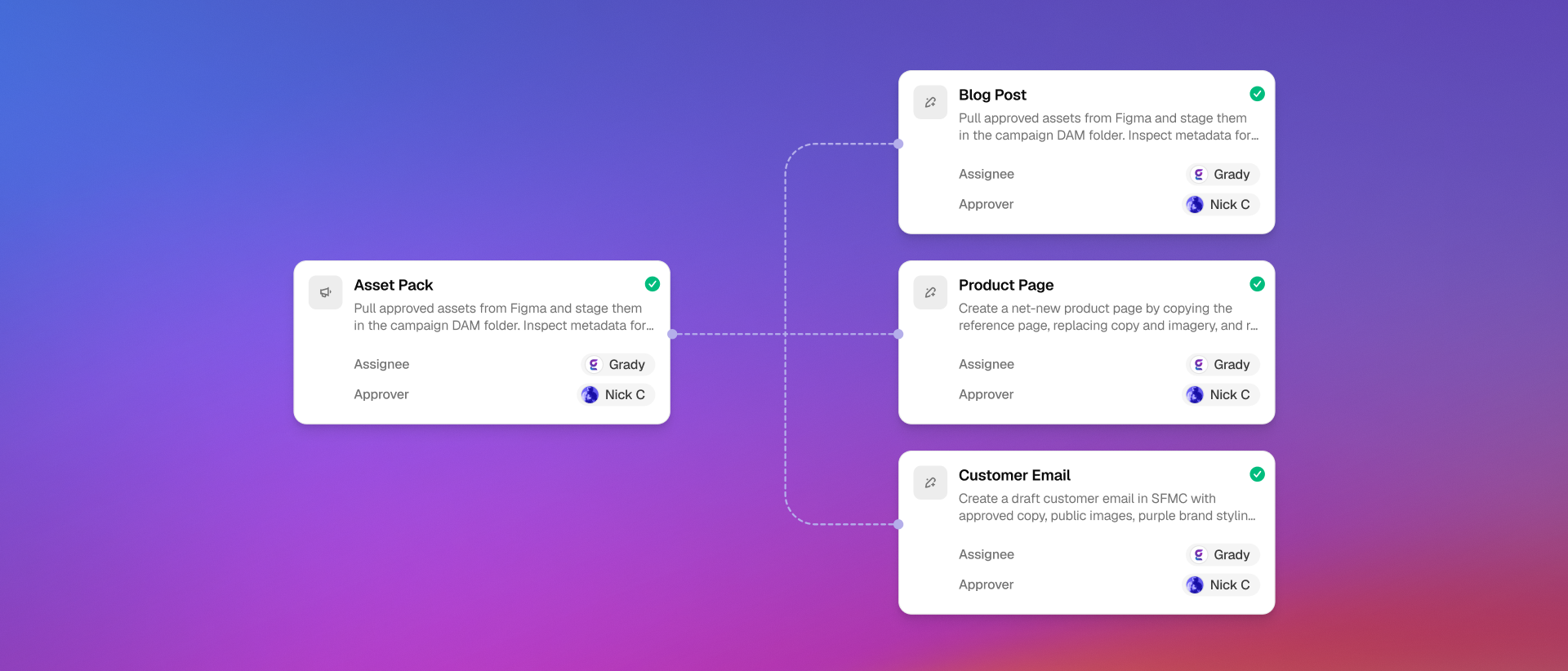
  • Request-to-work orchestration: Gradial turns briefs, tickets, designs, documents, and system events into scoped work with dependencies, owners, and review gates.
  • Reusable marketing context: Gradial applies brand, product, content, workflow, governance, and system guidance to the steps where it matters.
  • Execution in end systems: Gradial agents perform authorized work across connected CMS, DAM, ESP, analytics, collaboration, design, and workflow systems.
  • Governance inside execution: Permissions, quality checks, approvals, environment controls, and consequential actions stay visible and separate.
  • Reviewable evidence: Sources, changes, checks, exceptions, failures, retries, and rendered results travel with the work.
  • Learning from real outcomes: Approved feedback and workflow results improve the reusable instructions that guide future execution.

How to evaluate a marketing harness

Ask whether the harness can safely complete a recurring workflow, not whether it can generate an impressive sample.

  • Does it work across the stack? Look for native, controlled execution in the CMS, DAM, ESP, CDP, CRM, analytics, design, and workflow systems your team uses.
  • Does context persist? Brand rules, product facts, approved claims, designs, audience decisions, and workflow guidance should not depend on one perfect prompt.
  • Can governance vary by risk? A metadata draft, regulated claim, audience sync, campaign activation, and live publication should not share the same review path.
  • Can people inspect the work? Reviewers need the source, change, checks, spend, exception, and requested decision.
  • Does it verify the customer experience? The harness should confirm the visible page, email, asset, or campaign state after the final change.
  • Can value be measured? Track cycle time, handoffs, first-pass approval, defect escape, throughput, cost per approved outcome, and audience impact.

Research basis and update scope

This guide applies the emerging AI agent harness model to enterprise marketing. It was reviewed on August 21, 2026 using current technical definitions from Microsoft, Databricks, and LangChain, along with observed public use of “marketing harness” for brand-aware and channel-specific agent systems.

The marketing-specific definition and eight-control model are Gradial’s point of view. They extend the shared harness components of context, tools, state, orchestration, guardrails, observability, feedback, and human review into the operating realities of CMS, DAM, ESP, CDP, CRM, analytics, design, workflow, approvals, and release.

Because the category is emerging, this page should be reviewed as major agent platforms, enterprise governance practices, and market terminology change.

What a strong marketing harness produces

  1. One approved source of direction that travels through the workflow.
  2. One coordinated sequence across agents, people, systems, reviews, and release controls.
  3. Fewer manual handoffs between the approved decision and the customer experience.
  4. Evidence that lets reviewers decide without reconstructing the work.
  5. A verified result with workflow, quality, cost, and audience signals attached.